

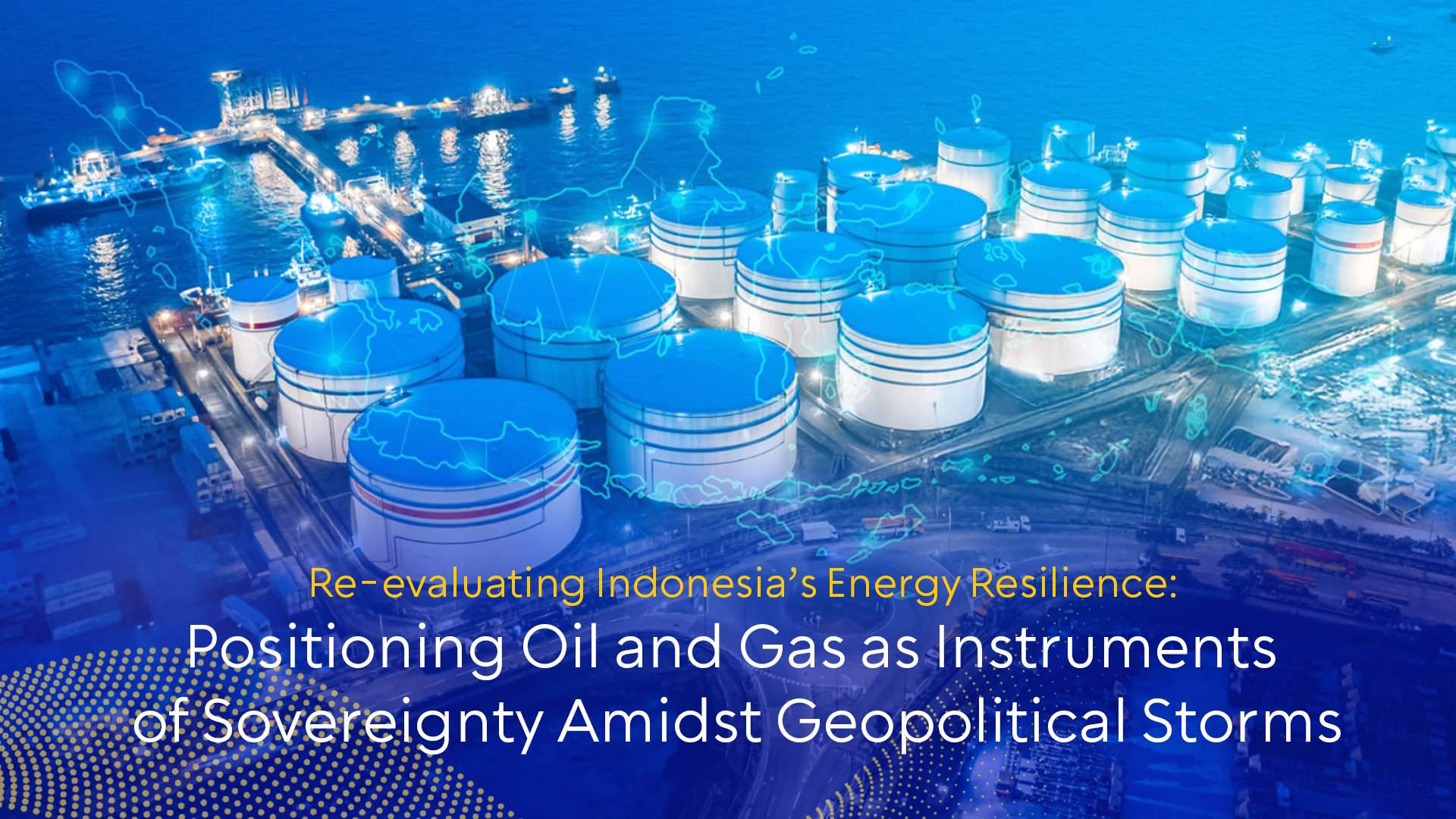
The current global energy landscape is no longer merely a matter of supply and demand dynamics within the commodity market. Geopolitical developments have transformed energy into a vital pillar of national security strategy. From the volatility of gas supplies in Europe to supply chain disruptions in the Pacific region, access to energy is now inextricably linked to a nation’s diplomatic bargaining power. In this context, oil and gas are no longer just economic commodities; they are strategic instruments that determine national resilience amidst global uncertainty.
For Indonesia, this situation serves as momentum to restructure its national energy strategy. Amid the global push toward decarbonization, oil and gas remain the primary anchors of energy stability. Without a realistic understanding of geopolitical dynamics, energy strategies risk losing their way within increasingly complex global supply chains. Energy resilience is not about merely following trends; it is about ensuring that every barrel of oil and cubic foot of gas contributes to national sovereignty.
The enactment of Government Regulation (PP) No. 40 of 2025 regarding the National Energy Policy (KEN) marks a significant step by the government to meet the challenges of the era. This document outlines an ambitious roadmap: a 30% utilization of New and Renewable Energy (NRE) in the energy mix by 2030, and the noble target of Net Zero Emission (NZE) by 2060. However, Dr. Sampe L. Purba—an observer of Energy Geostrategy—provides a crucial footnote: this policy must not be drafted in a “vacuum.”
"Does this target seem ambitious? Ambition is important, but if it is built upon assumptions of weakening economic growth, it becomes a concern," emphasized Sampe Purba during an interview with the IPA Convex Media team. This warning is well-founded. When a nation prematurely shifts its energy preferences to resources it has yet to master—both in terms of expertise and technology—it essentially opens the door to new forms of dependency.
National energy resilience must be viewed as an industrial strategy, not just an environmental agenda. Dr. Sampe L. Purba highlighted the nickel phenomenon as a bitter lesson; although Indonesia holds 41% of the world’s nickel reserves, the greatest added value is still enjoyed by external parties who control the technology. This lesson must serve as a mirror for the oil and gas sector. Owning reserves means nothing if control over the ecosystem remains out of reach. Without mastering the domestic value chain, Indonesia risks becoming merely a giant market for imported technology, while its domestic oil and gas potential remains underutilized.
Amidst the clamor for decarbonization, the oil and gas sector must be positioned as a primary buffer against external risks. In fact, Indonesia is facing an energy deficit that demands concrete action: domestic oil consumption has exceeded 1.5 million barrels per day (bpd), while national production stagnates at 600,000 bpd. This gap forces massive imports that undermine national fiscal strength.
A similar condition occurs in the gas sector, particularly with LPG, where the consumption of 8.05 million metric tons per year must be covered by 6.9 million metric tons of imports. Sampe Purba assesses that in an era of geopolitical fragmentation, securing domestic oil and gas production is non-negotiable. Import dependency is a vulnerability that can be exploited at any time by exporting countries or through global financial sanctions.
"Gas is not anti-transition; it is a buffer," he stated. Natural gas has a lower emission profile compared to coal while offering a level of stability (baseload) that intermittent energy sources lack. Therefore, natural gas is a strategic bridge that maintains national energy stability during the transition period. Optimizing production through the reactivation of idle wells, the implementation of Enhanced Oil Recovery (EOR), and the massive offering of new oil and gas blocks is not just a business matter—it is an emergency measure for sovereignty.
For stakeholders under the Indonesian Petroleum Association (IPA), the greatest challenge is not the availability of potential gas beneath the surface, but rather policy consistency. The oil and gas industry operates in long cycles of 20 to 30 years, requiring regulatory certainty above all else. Dr. Sampe L. Purba asserted that regulatory inconsistency directly increases the risk premium and the cost of capital, ultimately causing investors to adopt a "wait and see" attitude.
Indonesia cannot build energy resilience on the false assumption of global stability. Cross-sector coordination is absolute; national energy policy must go beyond paper. Synchronization between the government, State-Owned Enterprises (SOEs), and the private sector as strategic partners is required to ensure every policy can be implemented on the ground. "Energy is not just an economic commodity. For us, it must be an instrument of sovereignty," he concluded.