


TANGERANG – Indonesia’s efforts to navigate the energy transition and secure long-term investment in the upstream oil and gas sector require a strong regulatory foundation. Industry leaders and policymakers have therefore urged the government to expedite the revision of the Oil and Gas Law, which is seen as critical to providing long-term certainty for the national energy industry.
Purnomo Yusgiantoro stressed that a new regulatory framework is needed to ensure Indonesia’s oil and gas governance can adapt to future industry developments while also providing greater certainty for investors.
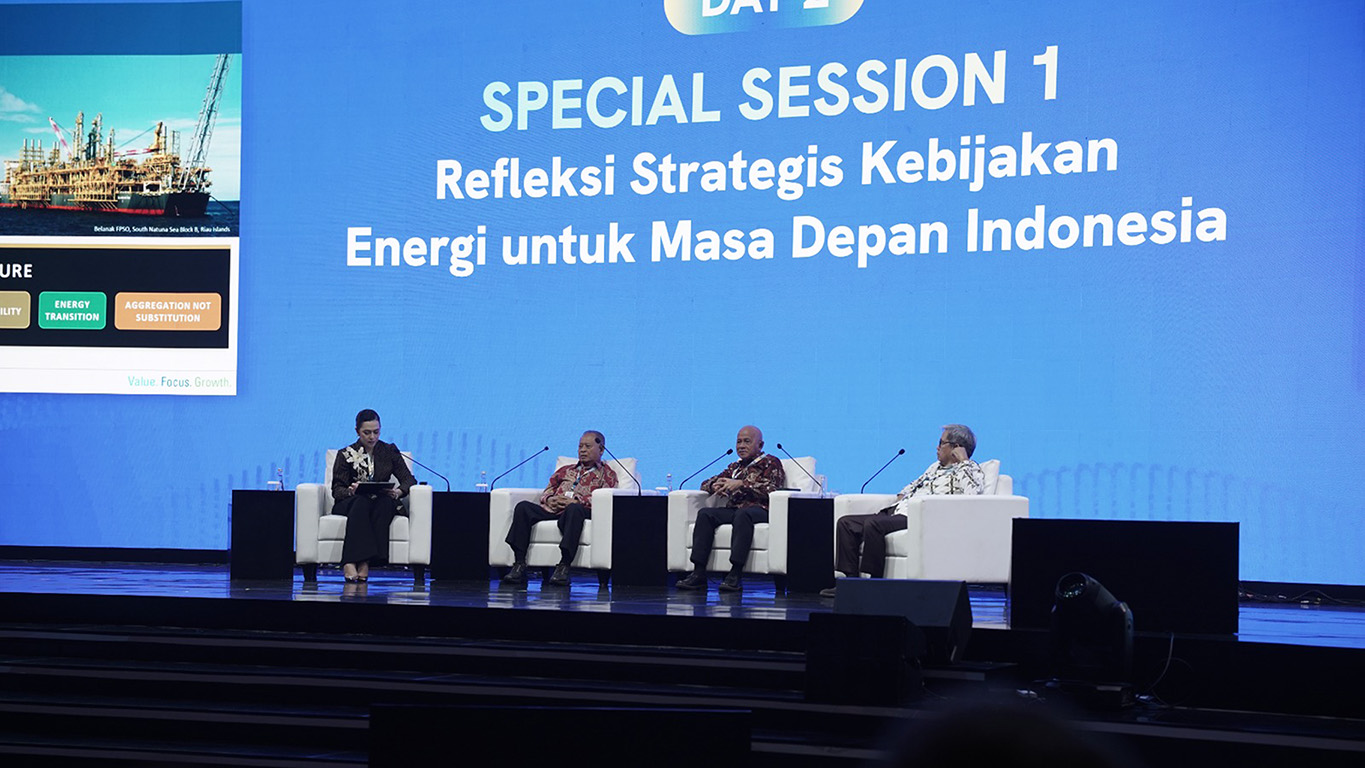
“We hope Indonesia will soon have a new regulatory framework and a new Oil and Gas Law,” Purnomo said during the Plenary Special Session – Reflection on Energy Policy Strategies for Indonesia’s Future at IPA Convex 2026 held at Indonesia Convention Exhibition BSD on Thursday (May 21, 2026).
Purnomo noted that Indonesia’s energy regulatory system is fundamentally well-structured, with a layered framework ranging from the 1945 Constitution and national laws to technical regulations issued by ministries and government agencies.
He explained that these strategic regulations are translated into tactical implementation through ministerial regulations and policies issued by institutions such as SKK Migas and BPH Migas.
“In fact, the system is already quite good. However, with a new Oil and Gas Law, we hope adjustments can be made to accommodate the industry’s needs for the next 20 years,” he said.
Beyond regulation, Purnomo emphasized the importance of balancing government interests with investor needs in order to keep Indonesia’s upstream sector attractive to global capital.
“The key is how we balance the government’s interests with the needs of the private sector,” he said.
According to Purnomo, oil and gas investors fundamentally seek attractive rates of return, given the high risks and uncertainties associated with exploration activities.
“The private sector always asks for a fair return because exploration is inherently risky and uncertain,” he added.
Meanwhile, Kardaya Warnika argued that the main challenge facing Indonesia’s upstream industry today is not a lack of resources, but weak legal certainty that has discouraged investment expansion.
He pointed out that several oil and gas companies have shifted their investments to countries such as Vietnam and Myanmar, which are perceived to offer more reliable regulatory certainty.
“Are their resource potentials better than Indonesia’s? The answer is almost the same. Indonesia’s potential is far greater. So why are investors moving there? Because there is legal certainty. That is the reason,” Kardaya said.
At the same forum, Hilmi Panigoro highlighted three major issues facing Indonesia’s oil and gas industry: the importance of legal certainty and the sanctity of contracts, the need for fiscal flexibility to maintain project economics, and the future of the industry amid the global energy transition.
According to Hilmi, the government’s current stance reflects increasingly positive policy direction for Indonesia’s upstream investment climate. “I fully agree with what Mr. Kardaya said — the sanctity of contracts and legal certainty are crucial,” Hilmi stated.