

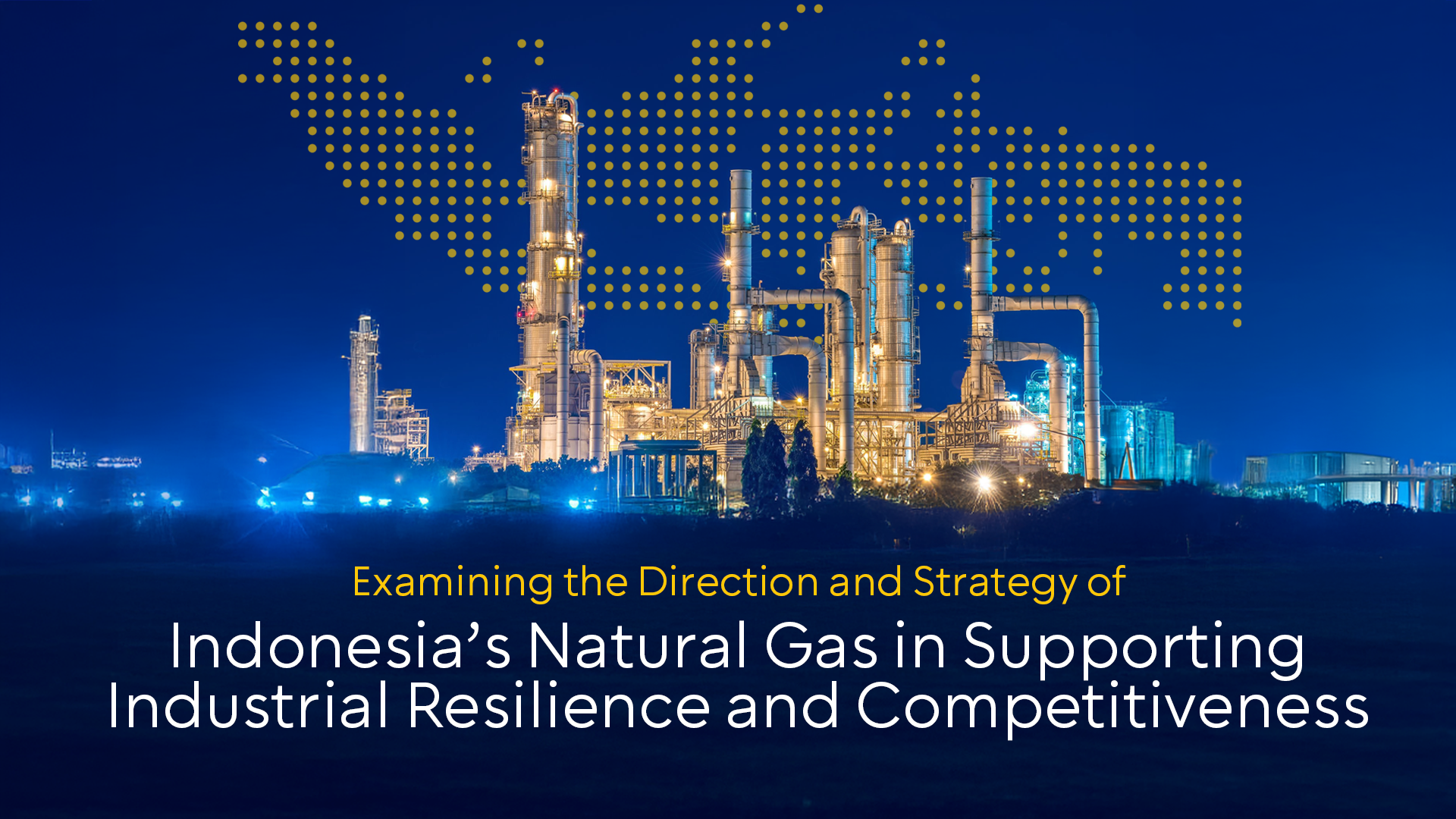
Natural gas occupies a strategic position within the national energy structure as one of the primary pillars supporting energy security and the sustainability of industrial activity. As a reliable and flexible energy source, natural gas plays a vital role in supporting manufacturing, power generation, and various strategic economic zones. In the context of national industrial growth, the sustainability of natural gas supply is not only related to energy availability, but also determines the competitiveness of Indonesia’s industry at the regional level.
The strategic role of natural gas becomes increasingly critical given the relatively large contribution of energy to industrial production cost structures. In several manufacturing subsectors, energy, particularly natural gas, can account for between 10 and 35 percent of total production costs, both as an energy source and as a feedstock. Therefore, certainty of supply and affordable natural gas prices are essential prerequisites for industry to maintain efficiency, increase capacity utilization, and plan sustainable business expansion.
In practice, however, the management of national natural gas resources continues to face structural challenges. Imbalances between supply and demand, infrastructure limitations, and fragmented cross-sector policies remain key issues affecting the effective utilization of natural gas for industry. Natural gas allocation and pricing policies regulated through various Ministry of Energy and Mineral Resources decrees, including Decree Number 91 of 2023, Number 255 of 2024, and Number 76 of 2025, reflect differentiated pricing schemes and gas volumes for industrial users across regions.
Under these policies, the Specific Natural Gas Price scheme was designed to support the competitiveness of seven priority industrial sectors. However, implementation on the ground shows that the utilization of this scheme has not been evenly distributed. In several industrial areas, only a portion of gas volumes receives the regulated price, while the remainder is subject to blended pricing between pipeline gas and liquefied natural gas. This situation creates regional variations in gas prices, which ultimately affect industrial cost structures and competitiveness unevenly.
Achmad Widjaja, Vice Chairman of the Forum Industri Pengguna Gas Bumi (FIPGB), assessed that the main challenge currently faced by industry is not only pricing, but also medium- and long-term supply certainty. According to him, industry requires clarity regarding volumes, prices, and the duration of supply so that production planning can be carried out in a rational and measurable manner. Without such certainty, industry tends to adopt a defensive stance and finds it difficult to optimize production capacity.
“For industry, gas is not merely an issue of production volume. What is most crucial is certainty of supply and consistent pricing. Without this, industry struggles to maintain cost efficiency and to plan sustainable business expansion,” he said.
This condition of uncertainty is reflected in the still moderate performance of the national manufacturing sector. Limited supply and fluctuations in gas prices make it difficult for industry to align production plans with national industrialization targets. In such circumstances, energy has not fully functioned as a driver of industrial growth, but rather as a variable that must be continuously adjusted in a reactive manner.
“When gas supply to industry is not guaranteed or becomes fragmented due to policy and infrastructure constraints, production costs increase. Over the long term, this condition can erode the competitiveness of Indonesian industry compared with other countries in the region,” he explained.
In addition, the complexity of natural gas governance, which involves multiple policy domains, further amplifies these challenges. Natural gas allocation falls under the authority of the Ministry of Energy and Mineral Resources, management and distribution are carried out by state-owned energy enterprises, while industrial development is the responsibility of the Ministry of Industry. Without strong coordination, natural gas policies risk becoming fragmented and losing their driving force in supporting national industrialization.
Within the framework of national energy security, the natural gas strategy should be positioned as a consistent and integrated long-term policy. Clear direction regarding domestic natural gas utilization, including the respective roles of pipeline gas and liquefied natural gas, is essential for industry to adjust technology investments, energy efficiency measures, and production structures. Such certainty also serves as a policy signal to businesses and investors regarding the state’s commitment to building a competitive energy ecosystem.
In this context, the Indonesian Petroleum Association, as part of the national energy ecosystem linked to the upstream sector and natural gas producers, expects stronger policies to ensure consistent and long-term natural gas governance. This approach is important to ensure that national gas allocation, which is largely directed toward domestic needs rather than exports, continues to maintain Indonesia’s attractiveness in the eyes of global upstream oil and gas investors.
Looking ahead, an integrated and predictable natural gas strategy will form a critical foundation for national industrial growth. Supply certainty, affordable pricing, and cross-sector policy alignment are essential prerequisites for natural gas to truly function as the backbone of energy security while simultaneously driving long-term industrial competitiveness.